
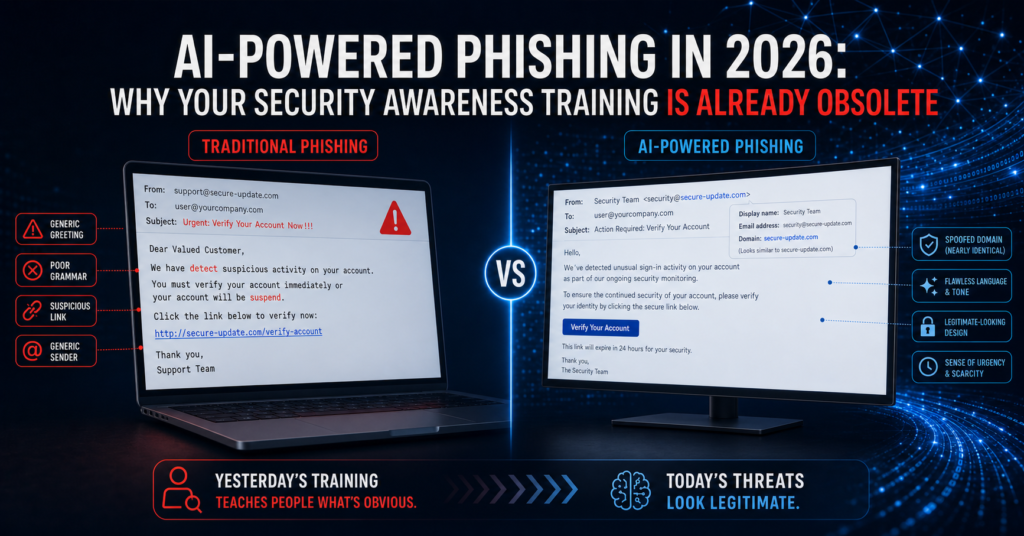
You Passed the Phishing Test. The AI Didn’t Care.
Your employees aced last quarter’s phishing simulation. Click rates are down. The security awareness programme looks great in the board report.
Then, on an ordinary Tuesday morning, three of your senior executives clicked a link that your email gateway missed, your awareness training never prepared them for, and your SIEM flagged — two hours and forty minutes too late.
Welcome to the era of AI-powered phishing.
This is not a hypothetical scenario. It is the lived reality of enterprise security teams right now. According to verified data compiled across multiple threat intelligence reports, 82.6% of phishing emails detected between September 2024 and February 2025 contained AI-generated content. That is not a niche trend. It is a fundamental restructuring of the threat landscape — and it demands a fundamental rethinking of how organisations defend against it.
This article breaks down exactly what changed, why your current programme may be leaving you exposed, and what a modern, AI-resilient email security strategy actually looks like.
The Old Playbook — And Why It Worked
Traditional phishing awareness training was built on a simple and largely accurate threat model. Attackers sent generic email blasts. The emails had recognisable red flags: awkward grammar, suspicious sender addresses, mismatched URLs, generic greetings, implausible urgency. Security teams taught employees to spot those signals. Simulations reinforced the behaviour. Click rates dropped.
It worked. In mature organisations, regular training programmes brought phishing susceptibility below 5%. Awareness training became a standard line item in every security budget, and with good reason.[^2]
Then generative AI arrived — and the red flags were engineered away.
The problem is not that employees forgot what they were taught. The threat model that training was designed to counter no longer exists.
What AI Has Done to the Attack
Modern adversaries using AI-assisted tools can now:
- Scrape your organisation’s public digital footprint — LinkedIn profiles, press releases, job postings — to map internal structures, team relationships, and recent business events
- Mimic the writing style of specific executives from their public communications, producing emails that sound exactly like the person they are impersonating
- Generate contextually rich, grammatically flawless lures that reference real internal projects, real colleagues, and real upcoming deadlines
- Produce thousands of unique polymorphic variants simultaneously, defeating signature-based email filters that look for known patterns
- Build an entire phishing campaign — email, landing page, and fake login portal — in under 5 minutes, compared to the 16 hours it would take a skilled human attacker to produce the same quality[^3][^4]
IBM security researchers tested this directly: AI needed only 5 prompts and 5 minutes to build a phishing attack as effective as one that took human experts 16 hours. The economics are equally alarming. AI-automated spear phishing achieves a 54% click-through rate while reducing campaign costs for attackers by approximately 95%.[^5][^4][^3][^2]
Think about what that means. The most dangerous attacks — the highly targeted, contextually convincing ones that were previously limited to nation-state actors with significant resources — are now available to any low-skilled threat actor with a subscription to a commercial LLM or access to tools like WormGPT or FraudGPT on the dark web.[^3]
The FBI has formally acknowledged this shift, warning that criminals are “leveraging AI to orchestrate highly targeted phishing campaigns” that produce messages “tailored to individual recipients with perfect grammar and style,” greatly increasing “the likelihood of successful deception and data theft.”[^5][^3]
The Numbers That Should End the Debate
The data removes any doubt that this is a mainstream enterprise threat, not an emerging one:
| Metric | Value | Source |
|---|---|---|
| Phishing emails containing AI-generated content | 82.6% | KnowBe4 / VIPRE (2025)[^1][^2] |
| Surge in AI-crafted phishing since ChatGPT launch | 1,265% | SentinelOne / SlashNext[^3][^6] |
| AI spear phishing click-through rate | 54% | Harvard Business Review 2024[^4][^2] |
| Orgs that experienced deepfake-assisted BEC | 25% | Industry survey 2025[^1] |
| AI campaign build time vs. human expert | 5 min vs. 16 hrs | IBM Research[^3][^4] |
| AI phishing cost reduction for attackers | ~95% | Industry analysis[^5][^2] |
| Annual global phishing losses | $25 billion | SentinelOne 2026[^2] |
| Average cost of a phishing-initiated breach | $4.8 million | IBM Cost of a Data Breach 2025[^7] |
| % of breaches involving a human element | 60% | Verizon DBIR 2025[^8] |
| % of organisations lacking formal AI security policies | 77% | Metomic / industry data[^6][^7] |
One figure deserves particular attention: 37% of all breaches now involve AI-generated phishing as the primary attack method. That is not just an email security problem. That is a board-level risk that lives in your organisation’s threat register right now — whether it has been put there yet or not.[^7][^2]
Why Awareness Training Alone Is No Longer Sufficient
To be clear: security awareness training is not dead. Research confirms that continuous, behaviour-driven training still reduces successful compromises — one 12-month longitudinal study involving more than 1,300 employees showed a nearly 50% reduction in successful phishing compromises within six months. That outcome is meaningful and worth preserving.[^9]
The problem is the gap between what training can address and what the threat now demands.
Traditional awareness training teaches employees to recognise signals of a bad email. AI phishing has systematically eliminated those signals. When an email has perfect grammar, references the team offsite from last month, comes from a convincingly close domain, and reads exactly like it was written by your CFO — the checklist your employees memorised provides no protection.
A cybersecurity awareness training programme built before 2023 leaves multiple modern attack channels entirely unaddressed. What is needed now is a layered security posture in which awareness training supports technical controls — not one in which it substitutes for them.[^8]
The 5-Layer Defence Framework
The following controls, applied in combination, represent the current best practice for AI-resistant email security.
1. Behavioural Analytics Over Template Recognition
Replace “can your employees spot the phishing email?” with “does this email deviate from the sender’s established behaviour patterns?”
AI-native email security platforms (Microsoft Defender for Office 365 with anomalous sender detection, Abnormal Security, Proofpoint Nexus AI) analyse communication baselines and flag contextual anomalies — not just keyword matches. An email requesting an urgent wire transfer from your CEO’s exact address may still get flagged if the sending infrastructure, timing, or phrasing pattern does not match historical behaviour.
2. Zero-Trust Email Authentication — Fully Enforced
Many organisations have DMARC configured at p=quarantine or p=none. In 2026, that is insufficient.
Enforce DMARC at p=reject for your primary domain and audit all trusted third-party senders. AI-powered phishing campaigns frequently exploit lookalike domains or compromised legitimate third-party accounts that your gateway inherently trusts. Strict SPF alignment, DKIM signing, and DMARC enforcement at rejection create a meaningful baseline that many attackers will route around to softer targets.
3. AI-Generated Simulation Content
If your phishing simulations still use static templates, you are training your workforce to recognise 2022 attacks. Platforms including Hoxhunt, Proofpoint, and KnowBe4 now offer AI-generated simulation content that adapts in real time, producing personalised lures that reflect your organisation’s actual environment. The simulation quality must match the threat quality.
4. Context-Aware Filtering with Semantic Analysis
Modern email filtering must evaluate intent, not just content. NLP-based semantic analysis can detect that an email is attempting to create urgency around a financial transfer or credential request — even when the email contains no malicious links and no known-bad content. This layer is specifically designed to address the class of attacks that AI phishing now delivers most reliably.
5. Process Controls That AI Cannot Bypass
This is the most underappreciated layer — and the one most directly within your control as a security leader.
No email alone should be sufficient authority for high-value, irreversible actions: wire transfers, credential resets, sensitive data access, vendor changes. Mandatory out-of-band verification via a separate, pre-established communication channel defeats deepfake-assisted Business Email Compromise at the process level, regardless of how convincing the email is. In 2026, 25% of organisations have already experienced deepfake-assisted BEC. That number will rise.[^1]
CISO 90-Day Action Plan
| Phase | Actions |
|---|---|
| Days 1–30 (Immediate) | Audit email security stack for AI/ML behavioural detection capability · Confirm DMARC policy is at p=reject · Replace static phishing simulation templates with AI-generated content |
| Days 31–60 (Short-Term) | Implement conditional access for high-risk email actions · Establish out-of-band financial transaction verification procedures · Brief leadership team on AI-enhanced BEC risk |
| Days 61–90 (Strategic) | Add AI phishing to board-level risk register with financial exposure quantification · Evaluate AI-native email platforms (Abnormal Security, Microsoft Defender, Proofpoint) · Build a continuous training programme that updates monthly, not annually |
The Uncomfortable Conclusion
The phishing threat of 2026 was not engineered to defeat your firewall. It was engineered to defeat your people — and it was built specifically to look like everything they were trained to trust.
A security awareness programme designed in 2020 was built for a different adversary. The red flags it taught employees to spot have been systematically removed. That is not a failure of your employees. It is a failure to evolve the programme alongside the threat.
The organisations that stay ahead of this are the ones applying the same technologies their adversaries are using: AI-driven detection, behavioural analytics, contextual filtering — layered on top of robust process controls that no language model can social-engineer around.
Your awareness training is still valuable. It is just no longer your first line of defence. In 2026, it needs to become part of a comprehensive stack — not the stack itself.
What is your organisation currently doing to evolve its email security programme for the AI era? Drop your perspective in the comments — this is a conversation worth having.
References
- 50 Phishing Statistics for 2026: Attack Costs, Trends & Prevention – 82.6% of phishing emails now contain AI-generated content, making traditional detection methods less…
- Phishing Statistics [2026]: Latest Attack Data & Trends – 3.4 billion phishing emails hit inboxes every day — and 82.6% of them are now AI-generated. Whether …
- AI-Generated Phishing: The Top Enterprise Threat of 2026 – Harvard research (cited in industry sources) finds that 60% of recipients fall for AI-generated phis…
- 60+ Phishing Attack Statistics: Insights for 2026 – Hunto AI – Phishing volume is surging again: Over 1.13 million phishing attacks were recorded worldwide in Q2 2…
- 82% of Phishing Emails Are Now Written by AI—And They’re Getting … – 82% of phishing emails now contain AI generated content. Attackers create personalized, grammaticall…
- AI Security Statistics 2026: Latest Data, Trends & Research Report – Increase in AI-powered phishing attacks targeting banks, 1,265% since … The top AI security risks …
- AI-Powered Phishing in 2026: How Generative AI Changed the … – Adversaries leverage jailbroken models, synthetic media, and model poisoning to enhance operational …
- Cybersecurity Awareness Training: Key Benefits for 2026 – Cybersecurity awareness training is a structured program that teaches employees to recognize and sto…
- Security Awareness Training for an AI‑Driven World: Why Behaviour … – What effective Security Awareness Training needs to prioritise in 2026 … 2026 Ultimate Guide to AI…
Published by Zaheer | CISO | cybermentor365.com
Sources: KnowBe4 Phishing Threat Trends Report, IBM Cost of a Data Breach 2025, Verizon DBIR 2025, SentinelOne 2026 Global Threat Report, FBI IC3 2024 Annual Report, Harvard Business Review AI Phishing Study 2024, IBM X-Force Threat Intelligence Index 2025